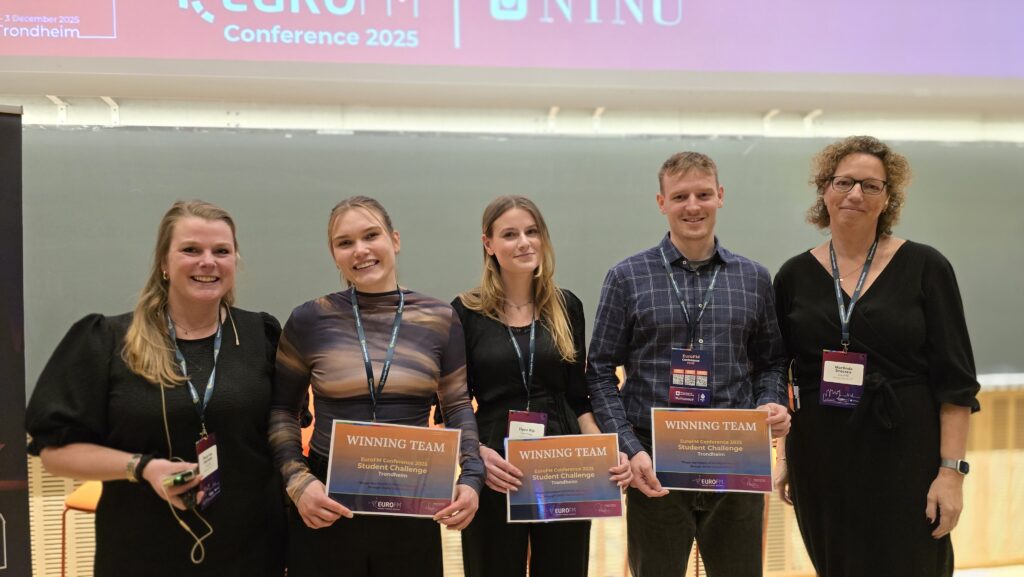
EuroFM Student Challenge 2025 Winning team: Kadi Matla, Dimitri Wolfisberg, Elyne Rip.
The EuroFM Student Challenge 2025 invited interdisciplinary student teams to explore how social sustainability can be strengthened within Facility Management. Our group focused on “Engagement and participatory approaches in FM” and “Diversity and inclusiveness, including gender and neurodiversity”. At the start, we formed a shared understanding that social sustainability in FM requires environments that support equity, inclusion, engagement and well-being. This became the basis for our research question: What common factors can be identified across best practice examples of inclusive Facility Management – and what can be learned from them for future FM strategies?
Our international team conducted desk research and six expert interviews in Switzerland, the Netherlands and Estonia. FM professionals described inclusion as moving away from designing for a “standard” user and instead acknowledging diverse needs. Literature showed that inclusion goes beyond minimum accessibility and requires welcoming, intuitive and adaptable spaces.
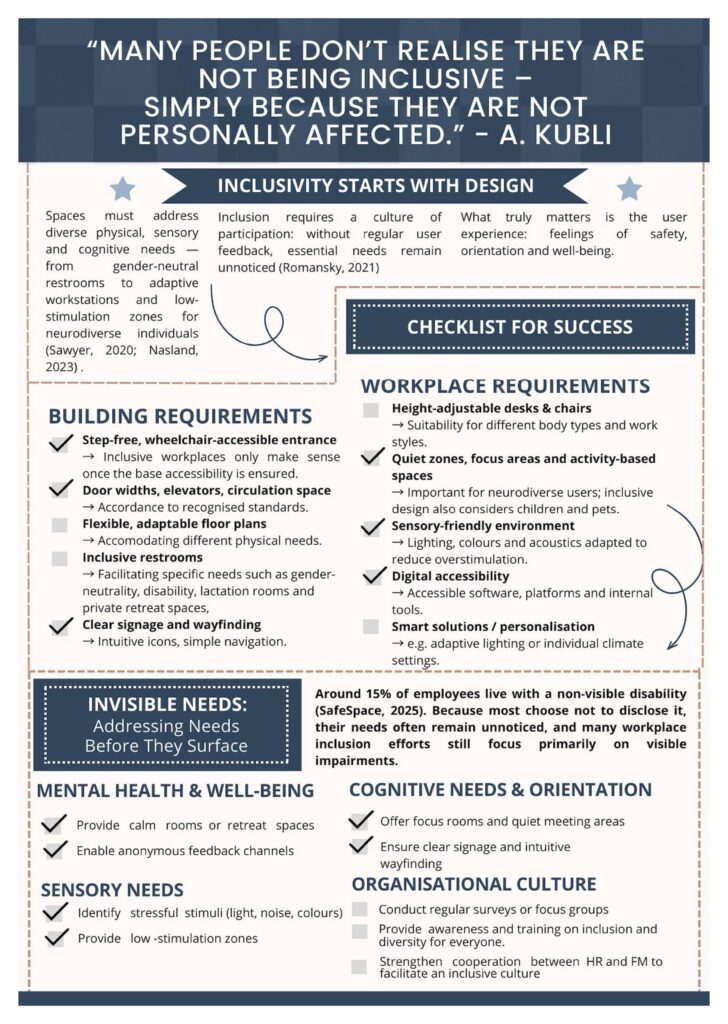
A key insight was the distinction between Building Requirements and Workplace Requirements. Building Requirements are fixed infrastructural foundations such as step-free access, circulation routes, lifts, door widths, barrier-free sanitary rooms and structural aspects like lighting, acoustic performance and ventilation. Since retrofitting is often costly or unrealistic, experts described Building Requirements as “non-negotiable pillars”.
Download checklist and research plan here!
Workplace Requirements, in contrast, are flexible and can be adapted throughout the building’s life cycle. They include ergonomic furniture, adjustable lighting, zoning for different cognitive and sensory needs, quiet rooms, gender-neutral areas and digital accessibility. Interviewees noted that many inclusive solutions occur “indirectly”, but more intentional FM practices are necessary to support neurodiverse and gender-diverse users.
Invisible needs appeared as a recurring theme. An estimated 15% of employees live with non-visible disabilities (SafeSpace, 2025). Interviewees such as A. Kubli and M. Moser explained that inclusive outcomes often happen unintentionally and that spatial conditions strongly influence well-being. FM should therefore proactively prevent overstimulation and provide retreat options.
Inclusion also depends on organisational culture and participation. Structured stakeholder involvement, surveys, feedback loops and transparent communication were emphasised as essential (Romansky, 2021; Tagliaro, 2023). Soft skills of FM staff significantly influence user satisfaction (TEAM, 2024; Sawyer, 2020). Challenges include cost constraints, space limitations, resistance to change and the lack of systematic standards.
Based on these findings, we created an infographic with four interconnected pillars: Building Requirements, Workplace Requirements, Invisible Needs and Organisational Culture. It serves as a practical checklist and conversation tool. Overall, inclusive FM requires awareness, early planning, flexibility and continuous dialogue. Measures that promote inclusion ultimately create better workplaces for everyone.