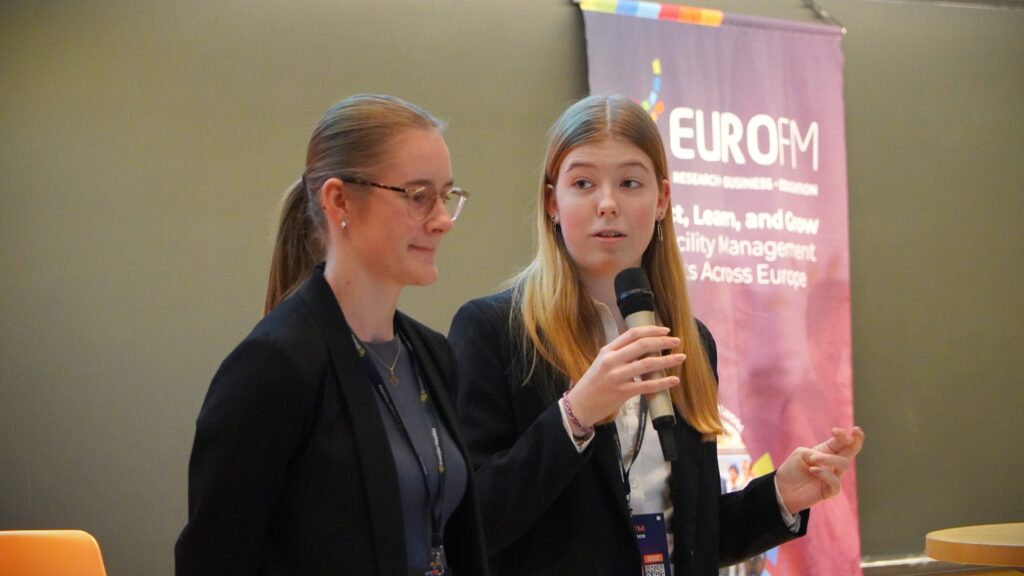
EuroFM Student Challenge 2025 team: Eline Nepperus, Maaike Salomons, Ghislaine Vogel and Felix Wadzah
During the EuroFM Conference 2025 in Trondheim, three international student teams took part in the annual Student Challenge, exploring how Facility Management can actively shape a more sustainable future. Team 1 focused on a topic that is increasingly central to the profession: social sustainability.
Their research began with a clear question: How can Facility Management strengthen social connection, belonging and community value in the workplace? Rather than approaching the topic from theory alone, each team member conducted in-depth interviews with FM professionals working in diverse geographical contexts, including the Netherlands, Ghana, Nigeria and the United Kingdom. This cross-cultural perspective allowed the team to identify patterns that transcend borders, sectors and organisational maturity levels.
What emerged from these conversations was a shared understanding that social sustainability is not an abstract concept. It is something people experience daily. It is reflected in leadership behaviour, in how colleagues greet each other, in whether spaces feel intuitive and respectful, and in whether repair, reuse and revitalisation efforts create pride rather than neglect.
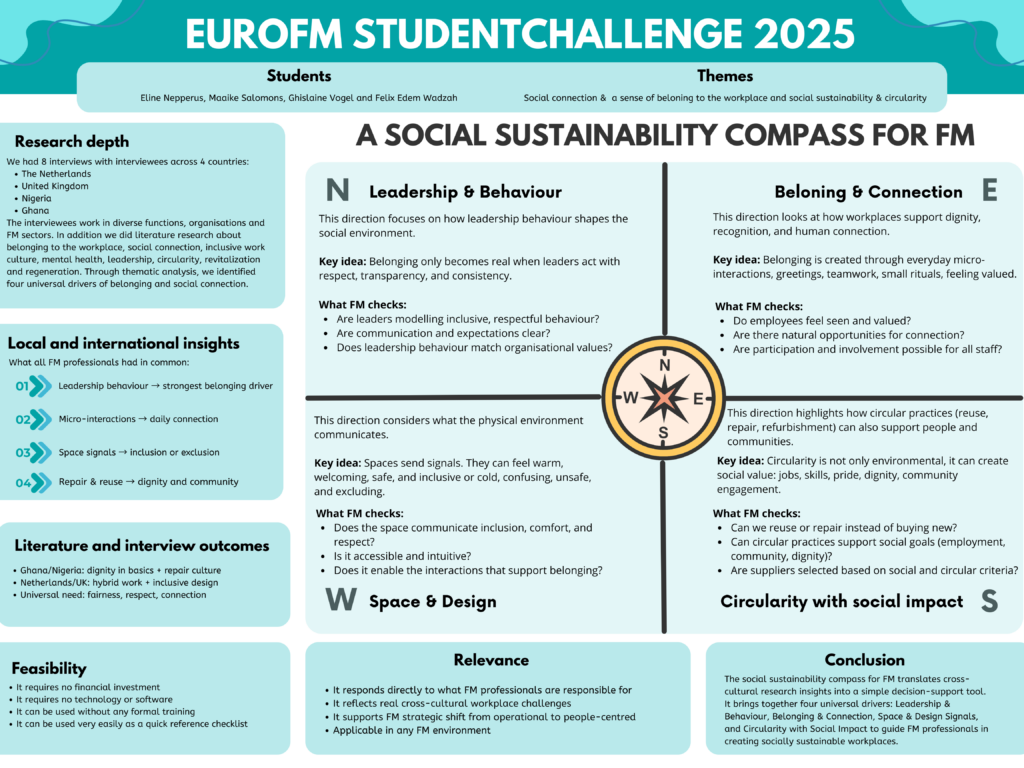
Across all interviews, four recurring insights stood out:
- Circularity and revitalisation generate social value when repair, reuse and responsible procurement strengthen community identity and stewardship.
- Leadership and behaviour play a decisive role in shaping dignity, trust and psychological safety.
- Belonging and connection grow through everyday micro-interactions, which require intentional design in hybrid work settings.
- Space and design act as a silent messenger, communicating organisational values before a single word is spoken.
Building on these insights, the team translated their findings into a practical framework: the Social Sustainability Compass. Rather than prescribing fixed solutions, the compass functions as a reflective tool. It helps FM professionals recognise the social impact of their decisions and initiate conversations within teams, leadership groups and project environments. Its simplicity and visual structure make it applicable across organisations of different sizes and cultural contexts.
The prototype was tested and refined during the conference itself. Participants described it as a valuable bridge between strategic sustainability ambitions and daily FM decision-making. The feedback confirmed what the research had already suggested: social sustainability is not a “soft” add-on to technical performance. It is an essential dimension of future-oriented Facility Management.
The work of Team 1 demonstrates that FM is uniquely positioned to influence human experience. From leadership dynamics to spatial design and circular practice, Facility Management shapes how people feel in their workplace, whether they experience belonging, and whether they see their environment as something to care for collectively.
This introduction highlights only the key findings and the development of the Social Sustainability Compass.
👉 Read the full article to explore the complete research approach, detailed insights, academic grounding and practical applications.