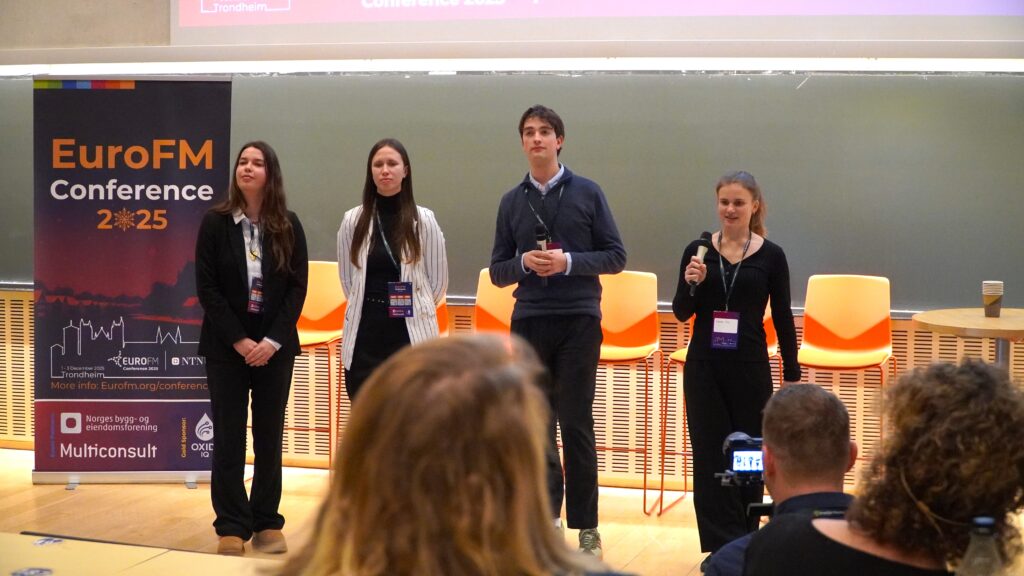
EuroFM Student Challenge 2025 team: Kamile Uikyte, Judith Bogema, Teun van Aalten and Isabelle Sigg
During the EuroFM Conference 2025 in Trondheim, three international student teams took part in the annual Student Challenge, exploring how Facility Management can actively shape a more sustainable future. Team 3 focused on a topic that is increasingly central to the profession: social sustainability.
Cities are becoming more digital, and AI plays a growing role in how public spaces and buildings are planned and managed. Although these technologies can improve efficiency and comfort, they also raise concerns about fairness, privacy, and who benefits from them. Because of this, it is important to understand how AI can be used ethically to support social sustainability in urban spaces.
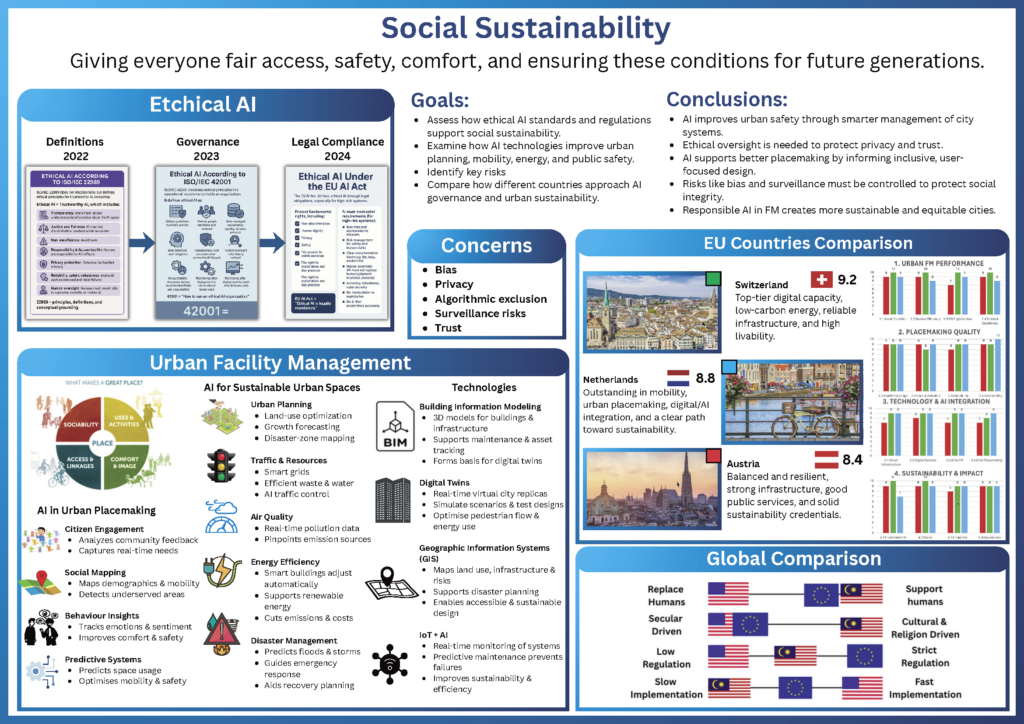
The importance of ethical AI, showing how definitions, governance standards, and new legal rules, such as the EU AI Act, aim to guide responsible use. Ethical AI focuses on reducing risks like privacy violations, algorithmic exclusion, and surveillance. It emphasizes transparency, trust and fair access for everyone. Clear guidelines help ensure AI develops in a way that protects people rather than harming them.
In Urban Facility Management, AI supports sustainable urban spaces through better planning, traffic and resource management, smart buildings, and energy efficiency. AI can help cities analyse mobility, detect patterns, and improve services like waste collection and lighting. Technologies such as digital twins, IoT sensors and real-time monitoring allow Facility Management to maintain safer, cleaner and more functional urban environments.
In the EU countries comparison, Switzerland, the Netherlands and Austria all score well, but for different reasons. Switzerland benefits from strong public services, the Netherlands is more focused on digital innovation, and Austria takes a steadier, more cautious approach. Even with these differences, they all show that combining technology with public involvement can support more socially sustainable urban spaces.
Finally, the social elements scale shows clear differences in how regions approach AI. The U.S. tends to move quickly with less regulation and a strong focus on automation, while Europe takes a slower, more controlled approach that tries to balance technology with human values. Malaysia is more cautious and bases its decisions on cultural and religious considerations, focusing a lot on data quality and governance. These differences show that AI adoption is closely linked to cultural norms and beliefs, and that understanding them is important for creating strategies that work across different regions.
👉 Read the full article to explore the complete research approach, detailed insights, academic grounding and practical applications.